| Subject: CT: East Timor still has stories
to tell
Canberra Times (Australia)
June 28, 2003
East Timor still has stories to tell
NOTHING fades as fast as an international crisis that seems to be
settled, as proved by the almost complete disappearance of East Timor from
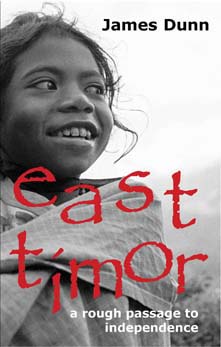
Australian newspapers and television screens. James Dunn's updating of his
history to cover its foundation as an independent nation reminds us of its
continuing importance to international politics.
His third edition drops the title of the first two, Timor: A People
Betrayed, and celebrates the independence for which the East Timorese
fought for more than two decades.
At the same time it provides an essential reminder of the barbarity of
the Indonesian military machine in trying to deny the East Timorese people
the independence conceded by its national government, and the difficulties
the East Timorese face in building a viable economy as well as a workable
democracy.
It also takes us back to the international deal that enabled Indonesia
to invade East Timor in 1975 after four centuries of Portuguese rule. The
decision of the Whitlam Government, in conjunction with the US
Administration, to turn a blind eye caused what Dunn describes as 'a
tragedy which cost more than 200,000 lives'.
The fall of the Suharto Government in 1998 and the arrival of Dr B. J.
Habibie as the new Indonesian president gave the independence advocates in
East Timor their first hope of getting rid of Indonesian authority, and
the East Timorese militia it had created. With the help of UN
Secretary-General Kofi Annan, Habibie proposed a form of autonomy. When,
six months later, John Howard urged him to address the Timorese desire for
self determination, Australia reversed its long-standing support for
continuing Indonesian control and dipped its toe into the question of
independence.
That brought in the United Nations and its Assistance Mission for East
Timor (UNAMET), in which Dunn was a volunteer observer, to prepare for a
referendum which would ask the East Timorese if they wanted autonomy from
Indonesia. When 78 per cent of the 98 per cent of eligible citizens who
turned out voted no for autonomy and thus yes for independence, the 17,000
Indonesian military in East Timor and their supporting militia reacted
immediately.
Dunn reports that, a few days after the announcement of the referendum
result, Dili was on fire and hundreds of thousands of East Timorese had
been ordered to leave or had fled inland. An indication of the depth of
destruction wrought by the military is his estimate that they deliberately
destroyed some 74 per cent of the houses and buildings in East Timor.
The arrival of the Australian-dominated interFET force and the later
formation of the United National Transitional Authority for East Timor (UNTAET),
in which Dunn was an adviser, brought an end to Indonesian reprisals and a
rapid transfer to East Timorese control. Dunn praises the spirit in which
it was achieved, but is critical of some aspects.
He is obviously impressed by the competence and outlook of President
Xanana Gusmao, but questions some of his priorities, particularly his
emphasis on reconciliation between different groups in East Timor. While
he acknowledges that his outlook has healed relationships between
supporters of independence and those favouring autonomy, he believes this
is only a part of the need for accommodation of past injustice. In the
interest of establishing the long-term relationship between Indonesia and
East Timor on 'a frank and enduring' basis, he sees a need for an
international tribunal to try those Indonesians responsible for crimes
against humanity.
He is also sceptical of the prospects for economic development,
labelling it 'not one of the great successes' of the activities of UNTAET.
He acknowledges the 'glittering hope' attributed to the Timor Gap gas
exploitation, but points out that it will not be a significant contributor
to revenue until the end of the decade. Rice and maize production have
recovered to the levels of 1999 and coffee has also increased
substantially, but at lower world prices. Unemployment levels have
remained 'dangerously high, posing a serious threat to security and
political stability'. He would also like to see more activity in tourism,
pointing to the beauty of the countryside and the richness and diversity
of the culture as attractions, particularly to Australians who have been
committed supporters of East Timor.
In that context, he is careful to distinguish between the people and
the government. He describes our national foreign policy as having a
history of 'ruthlessly opportunistic diplomatic manoeuvres that do nothing
to encourage complacency'. But he places much faith in the attitude of the
Australian people, which he describes as 'a commitment that has become a
matter of public conscience'.
This is an interesting update to a book that has provided an informed
and insightful view of East Timor since its first edition in 1983, but it
could usefully be embellished. The UN phase of the East Timor story has
had little coverage, apart from the well-balanced account by Ian Martin,
head of the UNAMET operation. If James Dunn would write a full account of
the independence phase his considerable contribution to a country in which
he has been involved for four decades would be strengthened.
Back to June menu
May
World Leaders Contact List
Human Rights Violations in East Timor
Main Postings Menu
|