|
|
 |
 |
make a pledge via credit card here
Background | Take Action | News | Links | What You Can Do | Resources | Contact
ETAN
Store | Estafeta |
Images |
Home |
Timor Postings |
Search |
Site Index | |


| Subject: Economist: Review of A
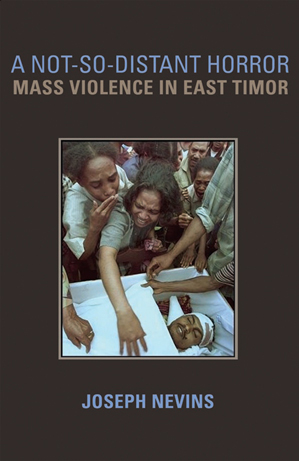
Not-So-Distant Horror
The Economist September 3, 2005 U.S. Edition BOOKS & ART A savage road to peace; East Timor THIS is a powerful and moving reminder of the horrors visited on East Timor, a tiny scrap of land that was exploited and neglected by its Portuguese colonisers for 420 years, repeatedly butchered and raped by the Indonesians from 1975 on, and now enjoys a precarious independence as the newest, and one of the poorest, countries on earth. The slaughter that was visited on East Timor after the Indonesian invasion was, in proportionate terms, one of the bloodiest ever. As many as 200,000 people died, a third of the territory's population. The memory of the killing haunted the occupation. Indonesians tried harder to develop Timor than the Portuguese ever did, but their guilt made them uneasy. Any attempt by the East Timorese to assert their right to justice, let alone to self-determination, was met with brutal responses, culminating in a massacre in the Santa Cruz cemetery in 1991. When the Indonesian dictator Suharto fell in 1998, his successor offered the Timorese a vote on independence. They seized the opportunity, but the Indonesian army with the Timorese militias it had spawned left only scorched earth and ruined buildings behind. All of this is well recounted by Joseph Nevins, an assistant professor of political geography at Vassar College in New York state. Where Mr Nevins moves on to more troublesome ground is when his book attempts to enlarge the circle of blame for all three atrocities, 1975, 1991 and 1999, beyond where it most obviously belongs with the Indonesian armed forces and government. He accuses all western governments, but principally those of America, Australia and Britain, of "complicity" in the carnage. Complicity is a slippery word, but there is a degree of truth in what he says. America, in particular, could have done much more to put pressure on the Indonesians to rein in their dogs of war, and America in effect gave Suharto the green light to move in 1975. All three countries clearly should have raised their voices in angry condemnation but failed to do so. In 1975 the British ambassador in Jakarta cabled London advising British diplomats to "keep our heads down" when the matter was debated at the UN. What niggles when reading Mr Nevins, though, is that he never attempts to explore reasons why the West felt it necessary to support Suharto in his occupation. One would not guess from his pages that when East Timor was invaded, it had shortly before been taken over by a communist-leaning government: that Saigon, Phnom Penh and Vientiane had all fallen to the communists earlier that year; that Suharto himself had come to power following dreadful misgovernment and a flirtation with communism in Indonesia, by far the largest country in South-East Asia. Alone, such considerations may not counter the charge of "complicity", but Mr Nevins should at least have tried to grapple with them. By 1991, and especially by 1999, these explanations anyway carry far less weight. Mr Nevins's accusations are particularly powerful when it comes to the lack of action following the Santa Cruz massacre in 1991. He understates the depth of world concern in 1999, which did, after all, lead to speedy UN resolutions and the mustering of a peacekeeping force under Australian command. It should, of course, have acted much faster, but that has much more to do with bureaucratic inertia than complicity. [For more info or to order book see etan.org/resource/booksetc.htm ]
Back to September menu |
|
|
Become an ETAN Sustainer, make a pledge via credit card here
Background | Take Action | News | Links | What You Can Do | Resources | Contact ETAN Store | Estafeta | Images | Home | Timor Postings | Search | Site Index |
|
|||||||||||||||||









|
|