West Papua Report
February 2010
This is the
69th in a series of monthly reports that
focus on developments affecting Papuans. This series is produced
by the non-profit West Papua Advocacy Team (WPAT) drawing on media
accounts, other NGO assessments, and analysis and reporting from
sources within West Papua. This report is co-published with the
East Timor and Indonesia Action Network (ETAN) Back issues
are posted online at http://etan.org/issues/wpapua/default.htm
Questions regarding this report can be addressed to Edmund McWilliams
at edmcw@msn.com.
Summary
Papuans have staged rallies in support of calls for a referendum
on West Papua's political status and to welcome efforts of international
support groups. New research has pointed to the persistence and
perniciousness of the Indonesian military's illegal logging. A new
attack on Freeport personnel re-enforces analyses that Indonesian
security forces are orchestrating the violence. An Indonesian NGO
and the Papuan branch of the Indonesian Human Rights Commission
say that rights protection in West Papua declined in 2009. A Human
Rights Watch report details rights violations in 2009. The Indonesian
military has named a senior Special Forces (Kopassus) officer to
head up the military in West Papua. The appointment conflicts with
Papuan efforts to begin a dialogue with the central government and
to demilitarize West Papua. The man chosen to replace independence
leader Kelly Kwalik, killed by the police in December, has pledged
to continue Kwalik's pursuit of a peaceful dialogue with Indonesian
authorities. The police who killed Kwalik have been honored for
their action. The Indonesian government plans to ban more books,
including some which address Papuan issues. The Indonesian Government
is moving forward with plans for a "food estate" in West Papua which
will expropriate land from local people and bring many non-Papuans
to the site as laborers. A local union and others have condemned
the plan as a "land grab."
Contents
| |
Indonesian military personnel at all ranks remain directly
involved in illegal logging. The involvement
is structural; low-ranked soldiers
to territorial commanders received a share.
|
Papuans Rally
in Support of Referendum and International Support Groups
Tempo Interactive reported January 28 that Papuans had launched
a campaign to support calls for a referendum. According to the report,
on January 27 "about one thousand Papuans in Timika rallied to support
the holding of a referendum on West Papua's political status."
The rally also supported the founding of two international support
groups for Papuans, the London-based International Parliamentarians
for West Papua (IPWP) and the Brussels-based International Lawyers
for West Papua (ILWP).
From his prison cell, internationally recognized prisoner of conscience
and West Papua National Committee (KNPB) Chairman Buchtar Tabuni
issued a press appeal calling on all Papuan to support these international
efforts.
Illegal Logging Remains
A Key Source of Funds for The Indonesian military
The University of Indonesia, in just-released research reported
by the Jakarta Post January 29, reveals that Indonesian military
personnel at all ranks remain directly involved in illegal logging.
The head researcher, Tirta N. Mursitama, told the Jakarta Post,
"(The military's involvement in this practice)
was structural; low-ranked soldiers to territorial commanders received
a share."
A team from the Center for East Asia Cooperation Studies (CEACoS)
at the University of Indonesia, uncovered the military's many roles
in the illicit business from coordinating to monitoring and investing.
The research covers the period between 1999 and 2006 in East Kalimantan,
and targeted illegal logging in border areas.
While the University of Indonesia research focused on illegal logging
in East Kalimantan, the practice is particularly widespread in West
Papua, as extensively documented in
The Last Frontier - Illegal Logging in Papua and China's Massive
Timber Theft, a 2005 report by the London-based Environmental
Investigative Agency (EIA) and the Indonesian Telepak.
"Down To Earth"
summarized the report in part: "... West Papua has become the
main illegal logging hotspot in Indonesia. As the forests of Sumatra,
Sulawesi and Kalimantan are increasingly logged out, timber operations
in West Papua are becoming more commercially attractive."
The EIA/Telepak report noted that 300,000 cubic meters of hardwood
merbau logs per month were smuggled from West Papua to wood processing
factories in China. The EIA/Telepak investigation revealed that
the logging and timber smuggling operations are supported and managed
by high-ranking Indonesian military (TNI) plus other government
officials and law enforcers.
The University of Indonesia research, as well as that of NGOs, journalists
and others underscores that notwithstanding efforts to reform the
Indonesian military by placing its business empire under civilian
control, lucrative illegal activity persists. That activity is particularly
extensive in West Papua where Suharto-era rules apply, meaning that
the military is broadly unaccountable to civilian authority (including
the courts).
New Armed Attack on Freeport
Personnel
Unknown gunmen have again attacked Freeport personnel on the military-guarded
road linking the mine site near Tembagapura with Timika. The attack
wounded Indonesian and foreign personnel. Among the wounded was
a child and an American citizen. The attack, the latest in a series
of attacks which began in July 2009, is especially embarrassing
to Indonesian military and police as it follows the December 2009
police killing of Kelly Kwalik, the long-time leader of the armed
resistance in the area whom security officials sought to blame for
the attacks.
| |
Moreover, the rights defenders noted
that activists were monitored and sometimes
subjected to intimidation while investigating
cases of human rights violations or after
meeting with diplomats and representatives
from international organizations.
|
The armed resistance has repeated Kwalik's previous
assertions that the attacks are not the work of the resistance.
Previous instances of security force-orchestrated violence in the
Freeport mine area, aimed at increasing Freeport payments to the
security forces, continue to fuel analyses that the security forces
are again behind the violence.
Indonesian activists: "Human
rights protection in Papua declined
in 2009"
The Commission for Missing Persons and Victims of Violence (Kontras)
and the Papuan office of the National Human Rights Commission (Komnas
HAM, a formal state organization) in a
January 17 joint presentation noted
that the human rights situation in West Papua experienced a "drastic
decline" in 2009.
According to the two organizations Indonesia continued to ignore
the protection of equality and human dignity, as well as the supremacy
of law in West Papua.
Kontras and Komnas Ham's Papuan branch contended that during 2009,
Indonesian authorities depicted Papuans as criminals for exercising
their legal rights. In particular, security personnel disparaged
Papuans who engaged in legal, peaceful demonstrations as "separatists."
Matius Murib of Komnas HAM Papua, accompanied by Kontras' Haris
Azhar and Syamsul Alam
during the presentation regarding human
rights in Papua in 2009 observed: "The criminalization of people
who raised [the Morning Star] flag, the breaking up of peaceful
demonstrations and the shooting to death of Kelly Kwalik are reflections
of a lack of government will to carry out dialogue with the community."
Moreover, the rights defenders noted that activists were monitored
and sometimes subjected to intimidation while investigating cases
of human rights violations or after meeting with diplomats and representatives
from international organizations.
Spokesmen for the two organizations concluded that display of the
morning star flag is a cultural, civil and political right guaranteed
under the Covenant on Civil and Political Rights and the Covenant
on Economic, Social and Cultural Rights, both of which were ratified
by the Indonesian Government in 2006.
The rights defenders also decried the failure of the Government
to implement the law on "special autonomy" with the consequence
of growing corruption and widening of the socio-economic gap within
Papuan society.
Human Rights
Watch Report Notes Rights Abuses in West Papua
The
20th
Annual Human Rights Watch (HRW) World report in the course of
reviewing human rights conditions in more than 90 countries and
territories notes serious abuse in West Papua during 2009. Drawing
on its previously noted "What
Did I Do Wrong" (see
July 2009
West Papua Report) the annual report notes
that in Merauke, West Papua, Special Forces (Kopassus) arrested
Papuans without legal authority and subjected them to beatings and
mistreatment at the Kopassus barracks.
In the wake of these abuses, HRW notes, commanders made no effort
to uphold military discipline or to hold soldiers accountable. In
fact, WPAT has learned, Kopassus has prepared a report which purports
to contradict certain HRW findings. The HRW annual report also notes
that in March 2009, the Ministry of Foreign Affairs ordered the
International Committee of the Red Cross (ICRC) to close its field
offices in Jayapura (as well as in Banda Aceh in Aceh).
The portion
of the annual report dealing with abuses affecting Papuans follows:
Indonesian authorities have responded to
a longstanding, low-level armed separatist insurgency in the
provinces of Papua and West Papua with a strong troop presence
and often harsh and disproportionate responses to non-violent
dissent or criticism. Human Rights Watch has long expressed
concerns over anti-separatist sweeps by the police, which often
result in individuals who peacefully express support for independence
being arrested and detained on charges of treason or rebellion
(makar).
The government continues to restrict access by foreign human
rights monitors and journalists to Papua, exacerbating the existing
climate of impunity and making investigations extremely difficult.
Prior to being ordered to close its Jayapura office, the ICRC
had been visiting detainees in Papua's Abepura prison, where
prison guards continued to torture inmates, including political
prisoners Buchtar Tabuni and Yusak Pakage.
In July a series of shootings at the Freeport goldmine in Timika
left three people dead, including one Australian. Police, declaring
that the Free Papua Movement (OPM) was involved in the attacks,
arrested at least 20 Papuans in relation to the killings and
declared seven as suspects. The OPM denied any involvement,
and those targeted by the police insisted that they were neither
affiliated with the OPM nor participants in the attacks. In
November police released the final seven Papuans detained in
connection with the incident. In November a Manokwari district
court convicted three men of makar (rebellion), for raising
a pro-independence flag.
Kopassus
Officer Named to Head Military in West Papua
The West Papua Advocacy Team (WPAT) and the East Timor and Indonesia
Action Network (ETAN) in a
January 24 statement
described the naming of senior Special Forces (Kopassus) Officer
as Indonesia Military Commander in West Papua as "profoundly disturbing."
The statement noted the
"dark history"
of Kopassus in West Papua and elsewhere and recalled recent
and continuing reporting of Kopassus abuses targeting the Papuan
population. WPAT and ETAN noted that the appointment would undermine
efforts by Papuans to launch a dialogue with the central government
and to demilitarize West Papua.
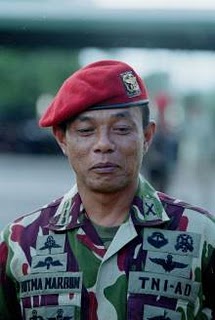 The
new commander, Major General Hotma Marbun, has
served in West Papua and in East Timor during periods of brutal
repression. A statement by the Indonesian military chief of staff
at the transfer of command ceremony indicated that the military
would continue to focus on purported "separatist" threats. The military
and police in West Papua routinely allege that Papuans defending
human and civil rights are "separatists" and used the false charge
to pursue crack downs against Papuans who assert their rights. (See
full WPAT/ETAN statement at
http://www.etan.org/news/2010/01hotma.htm)
The
new commander, Major General Hotma Marbun, has
served in West Papua and in East Timor during periods of brutal
repression. A statement by the Indonesian military chief of staff
at the transfer of command ceremony indicated that the military
would continue to focus on purported "separatist" threats. The military
and police in West Papua routinely allege that Papuans defending
human and civil rights are "separatists" and used the false charge
to pursue crack downs against Papuans who assert their rights. (See
full WPAT/ETAN statement at
http://www.etan.org/news/2010/01hotma.htm)
Kwalik Replacement Pledges Continued Pursuit
of Peace Initiative
A
January 10 press release from the West Papua National Coalition
for Liberation (WPNCL) announced that General Jeck Milian Kermong
was elected to be the new Commander of KODAM III/Nemangkawi, succeeding
Kwalik who was killed by the Indonesian police in late 2009. The
election took place December 25, 2009 at an extraordinary meeting
of the leadership of Free Papua Movement (OPM) at a military ceremony
at the Headquarters of the KODAM III [Military Area Command III]/Nemangkawi
in the central highlands of West Papua.
According to a
January 10 report in the Vanuatu Daily
Post, General Jeck Milian Kemong was close to Kwalik. He was
born in Tsinga Village, the son of landowners in the Freeport mining
area. He attended primary school in Amungun, Akimuga District with
the late Kelly Kwalik in the 1960s. He subsequently attended the
former Catholic seminary in Abepura from 1968 to 1971. He joined
the OPM in 1977 and in that year participated a military action
that destroyed the main pipeline at the Freeport copper and gold
mine.
In a statement to the general public, Kemong asserted that the killing
of Kwalik "will never undermine peaceful dialogue that has already
been in progress." Kemong pledged to continue the peace initiative
until a lasting peace is achieved in West Papua."
For many years, accepting appeals from leaders of Papuan civil society,
Kwalik and many of the OPM leadership had observed a halt to most
military activities in support of peaceful initiatives by civil
society leaders to end security force abuse of human rights and
the demilitarization of West Papua. Shortly before his killing,
Kwalik had met with police officials in service of those goals.
Police Honored for Killing Kwalik
The Indonesian National Police headquarters on January 20 honored
a team of 50 police officers with special commendations for the
December 2009 shooting
and killing Kelly Kwalik, the charismatic leader of the pro-independence
Free Papua Movement (OPM). Police had been faulted for their handling
of the incident: Kwalik died of a leg wound, apparently because
police failed to staunch the wound, allowing Kwalik to bleed to
death.
In the wake of the shooting police officials claimed that Kwalik
has been involved in series of attacks in the area of the Freeport
copper and gold mine in West Papua. These claims contradicted earlier
statements by the police themselves that Kwalik was not involved
in those attacks. Kwalik also had denied involvement. Giving credence
to Kwalik's claims of non-involvement, unknown gunmen have staged
a new attack on Freeport personnel (see separate item this issue).
A
media report quoted one of the police involved in the Kwalik
shooting as stating that police were now attempting to track down
Goliath Tabuni, another senior member of the rebel group.
Indonesian Government to
Ban Books, Including Translation of the
UN Declaration on the Rights of Indigenous People
| |
Is Indonesia's
democracy so fragile that it cannot allow
the raising of the West Papuan Flag and
books on the issue of West Papua?
|
The Indonesian Attorney General's office (AGO) plans
to ban 20 additional books, including at least three which address
human rights violations in West Papua
and Indonesia's annexation of that territory.
The banning would be justified by claims that the books fuel separatist
sentiments, echoing those presented by the Suharto dictatorship.
"We do not want to see Indonesia separated," claimed
the Head of Research and Development of the Justice and Human Rights
Department Hafid Abbas.
The forbidden books will include The Indigenous World 2009,
published by the International Working Group for Indigenous Affairs,
edited by Kathrin Wissendrof. This publication was launched at the
UN Headquarters in May 2009. Other books include: Hak Asasi Masyarakat
Adat, a translation into Bahasa Indonesia of the UN Declaration
on the Rights of Indigenous People and Sendius Wonda's Rakyat
Papua Barat Mencari Keadilan (A Nations Plea: West Papua People
Looking for Justice).
Joe
Collins of the Australia West Papua Association
(Sydney) said, "is Indonesia's democracy so fragile that it
cannot allow the raising of the West Papuan Flag and books on the
issue of West Papua? The banning of freedom of expression is contrary
to the International Covenant on Civil and Political Rights (ICCPR).
Instead of banning books on West Papua the Indonesian government
should be allowing the West Papuan people to discuss human rights
and self determination in their country." AWPA called on The Indonesian
Constitutional Court to revoke the authority of the Attorney General's
Office (AGO) to ban books in the country.
WPAT, for its part, notes that in banning the publication of the
Bahasa Indonesian translation of a fundamental UN document, i.e.,
the UN Declaration on The Rights of Indigenous People, Indonesia
has sought to impede access to a UN declaration for which it voted
(in 2007).
 |
|
Church
Voice for the Suffering People: No More Blood and Tears
in West Papua, by Socrates Sofyan Yoman
|
Indonesia's censors have been busy recently. Last
year, they banned the Australian-produced feature
film Balibo, about the murder of foreign journalists in the lead
up to Indonesia's full scale invasion of East Timor in 1975. Shortly
thereafter, five book were banned, including a recent
Indonesian
translation of John Roosa's 2007 book on 1965 and Church
Voice for the Suffering People: No More Blood and Tears in West
Papua, by Socrates Sofyan Yoman.
The Indonesian Government "Food Estate"
Plan to Expropriate Papuan Lands and Flood Area with Migrants
 |
|
| Wamena women
selling cabbage in a Papua market. Antara Photo |
|
Agriculture Minister Suswono has
told the media that the Indonesian government has finalized
plans for the country's first integrated food production zone in
Merauke, West Papua. The pilot project, comprising 1.6 million hectares,
aims to attract domestic and international investors with a series
of tax breaks and could be a model for other such zones in eastern
Indonesia. The project envisions integrated farming including a
plantation and livestock zone, where companies will process and
package their products in one place. The government plans to give
investors financial incentives such as tax breaks and reductions
in customs and excise duty, according to the ministry.
According to the Ministry, the government will "streamline" the
land acquisition process and facilitate immigration for foreign
workers. In practical terms, Papuans will be forced to sell their
land in what the Indonesian Farmers Union (SPI) a "land
grab" by big business at the expense of local people. This will
eventually lead [the country] to losing sovereignty in our food
[production], the union said. Food estates could also lead to feudalism
because the role of the indigenous farmers will be just to provide
labor to the capital owners. The union also said executives from
Binladin Group, a Saudi Arabian conglomerate, have visited Merauke
to examine the projects potential.
Local people and NGOs have also protested over associated social
and environmental problems posed by the "estate" plan. Bungaran
Saragih, a former agriculture minister, expressed similar concerns.
There is potential for social conflict between the original residents
and the newcomers, he told the Jakarta Globe in December.