
|
 |
West Papua Report
|


|
|
|
|
Landslide on a deforested hillside near Jayapura, Papua. With fewer tree roots to hold soil, landslides can become more common in deforested areas. Photo by Rhett A. Butler. |

Despite being covered in commodity concessions and viewed by some as becoming a
focal point for the Indonesian government's palm oil development in the country's eastern half, the provinces of Papua and West Papua have, rather mysteriously, recorded very low deforestation rates compared to the rest of the archipelago. This may seem odd to some observers, especially given the number of reports and photos that have poured out of the two provinces highlighting the exploitation of their jungles.But rather than represent a pleasant surprise
for environmentalists and the peoples inhabiting these restive lands, the
reality of the situation is a bit more complex. While it may be understood
that large-scale deforestation in Papua and West Papua is still in its early
stages, finding accurate deforestation data for these two provinces is no
easy task. As a result, conflicting numbers published by the government
and NGOs tell vastly different stories about what's really happening on
the ground.
Let's start out with official government data. The Indonesian Ministry of
Forestry, an agency
viewed by some as corrupt and mismanaged , claims
in its
2013 Forest Area Statistics report that West Papua lost 20,285
hectares of forest from 2011-2012, while it provided no deforestation data
for Papua province. Attempts by mongabay.com to clarify this absence of
data with the ministry were unsuccessful.
Meanwhile, data from
Global Forest Watch (GFW) largely uphold the government's numbers
for West Papua, with 22,389 hectares of tree cover lost from 2011-2012,
and Papua losing 64,230 hectares during the same time period. In all, Papua
and West Papua lost 250,542 hectares and 122,885 hectares, respectively,
from 2001-2012.
In comparison to the forest loss of Indonesia as a whole, which reached 840,000 hectares in 2012 alone , the forests of Papua and West Papua have remained relatively unscathed. But although deforestation has not been as rampant in these regions as it has been for other Indonesian provinces, Charles Tawaru, Greenpeace's forest campaigner in Papua, says that one thing is for certain: "The forests of Papua and West Papua continue to be degraded."
|
|
|
|
Data from Global Forest Watch show Papua and West Papua have significant concession coverage, with logging concessions dominating the lowlands. Many intact forest landscape (IFL) areas have been degraded since 2000. Click to enlarge. |

Global Forest Watch data
show an upward
trend of deforestation in Papua, with tree cover loss nearly
doubling between 2011 and 2012, and GFW maps indicate that much of Papua's
tree cover loss occurred in the large number of timber and, to a lesser
extent, palm oil and wood fiber concessions that dot its land. As timber
concessions become depleted across other parts of the archipelago, namely
Sumatra and Kalimantan, intact forests in Eastern Indonesia risk further
depletion.
"At the moment, logging — legal and illegal — and plantations are the main
drivers [of deforestation] in Papua," Yuyun Inradi, Greenpeace's forest
political campaign team leader, told mongabay.com.
Logging has traditionally driven most of the provinces' deforestation, but
West Papua, according to Greenpeace, is currently undergoing something of
a palm oil boom in certain regencies. Indonesia remains the world's largest
producer of palm oil and, as stated in a
recent working paper published by the Center for International
Forestry Research (CIFOR), the country is targeting to produce 40 million
tons a year by 2020 — twice the output it recorded in 2010.
"In the provinces of Papua and West Papua, the area of oil palm plantations
is low compared to other regions," states the CIFOR paper. "However, it
is growing at a steady rate."
But not all concessions in Papua and West Papua are being developed at the same pace. Global Forest Watch shows some concessions in the provinces contain intact forest landscapes (IFLs) that have been degraded, while others are completely void of IFLs. On the other hand, many of the concessions on the map appear to have large swaths of IFL.
|
|
|
|
The Merauke region of Papua, which borders Papua New Guinea to the east, is dominated by concessions, many of which contain intact forest landscapes (IFLs). Map courtesy of Global Forest Watch. Click to enlarge. |

Still, given how much area concessions cover
in the provinces, deforestation figures remain unusually low. After all,
according to
government figures cited by Greenpeace, Papua contains about a third
of the remaining rainforests in Indonesia, a country that not too long ago
gained international notoriety for surpassing Brazil as the world's largest
deforester in terms of annual rate.
Yuyun claims that the presence of concessions doesn't necessarily translate
to active deforestation, especially when it comes to timber plots. "There
are a lot of logging concessions that still have active licenses but have
no activity on the ground," he said. "Those that still have tracts of IFL
could be new or inactive old concessions."
Meanwhile, palm oil concessions represent
both a present and future issue for Papua's forests. Sorong and Manokwari
regencies are currently palm oil hotspots in West Papua, a province that
has seen its area of palm oil estates increase from 31,000 hectares in 2007
to 70,000 in 2011, according to CIFOR.
In Papua province, the Merauke Integrated Food and Energy Estate (MIFEE)
has attracted a lot of attention from activists and local communities alike
for its wide-ranging concession grants. According to a
2012 Greenomics report, MIFEE is slated to cover over one million
hectares of agricultural land in the Papuan region of Merauke.
Although only two of 10 proposed blocks were to include palm oil,
Greenpeace has previously noted that "significantly" more palm
oil concessions were to be included. According to Yunyun, roughly 600,000
hectares included in the project's limits have thus far been opened up for
production.
Because of how sensitive they are politically and how valuable they are
economically, the provinces of Papua and West Papua represent major development
priorities for the Indonesian government and are therefore prone to the
effects of extractive industries. Although the situation may be hard to
definitively gauge given spotty information, deforestation in the West Papua
region may be more widespread than any published data purport.
Citations:
- Greenpeace, University of Maryland, World Resources Institute and Transparent World. 2014. Intact Forest Landscapes: update and degradation from 2000-2013. Accessed through Global Forest Watch on Jan. 27, 2015. www.globalforestwatch.org.
- Hansen, M. C., P. V. Potapov, R. Moore, M. Hancher, S. A. Turubanova, A. Tyukavina, D. Thau, S. V. Stehman, S. J. Goetz, T. R. Loveland, A. Kommareddy, A. Egorov, L. Chini, C. O. Justice, and J. R. G. Townshend. 2013. "Hansen/UMD/Google/USGS/NASA Tree Cover Loss and Gain Area." University of Maryland, Google, USGS, and NASA. Accessed through Global Forest Watch on Jan. 27, 2015. www.globalforestwatch.org.
- "Logging." World Resources Institute. Accessed through Global Forest Watch on Jan. 27, 2015. www.globalforestwatch.org.
- "Oil Palm." World Resources Institute. Accessed through Global Forest Watch on Jan. 27, 2015. www.globalforestwatch.org.
- UNEP-WCMC, UNEP, and IUCN. "World Database on Protected Areas." Accessed on Jan. 27, 2015. www.protectedplanet.net.

United Liberation
Movement of West Papua Adopts Constitution,
Submits Application for Membership in Melanesian Spearhead Group (MSG)
In early February, the new coalition, the United Liberation Movement
of West Papua (ULMWP), (see January 2015 West
Papua Report) published the movement's
Constitution. At the same time, the ULMWP produced its formal application
for membership in the Melanesian Spearhead Group (MSG). The Constitution
and application flow from the December 3, 2014
Saralana Declaration,
which formalized the unity of three key West Papuan groups: West Papua National
Coalition for Liberation WPNCL); Federal Republic of West Papua (NRFPB)
and National Parliament for West Papua (NPWP). The Saralana Declaration
pledged that the organizations would speak with "one voice."
|
|
|
|
President of the Malvatumauri National Council of Chiefs, Vanuatu, leads the united members of the West Papuan independence movement to the MSG to submit their application for full membership. freewestpapua.org/ |

The Constitution
states that the principal objective of the ULMWP is to represent "the aspirations
of the West Papuan people in seeking to determine their own future and political
status." The document describes the group's vision to "establish a free
and democratic nation state called West Papua" and pledges to "faithfully
represent the aspirations of the West Papuan people in their struggle for
self-determination, using peaceful means." It declares the new unity organization's
intention to "build sub-regional, regional and global solidarity" in a common
effort to "seek diplomatic support and recognition for our just cause."
In that effort, the ULMWP underscored that its 'first objective" would be
to seek membership in the MSG."
ULMWP Secretary General Octovanius Mote
formally handed the group application to the MSG's Director General,
Peter Forau on February 3. Mote said "today the hearts of our Papuan people
are with us as we make this application to be properly recognized by the
family of Melanesia. We believe we have fulfilled the criteria asked of
us by the MSG, and we trust the MSG will process our application with due
deliberation."
Mote added that at its 2013 summit in Noumea, the leaders of the MSG "endorsed
our 'inalienable right to self-determination' but asked us to unify under
one group so as to be representative of all the Papuan people. Last December
we achieved this unification during a historic reconciliation meeting here
in Port Vila, thanks to the support of both the Vanuatu government and Pacific
Council of Churches."
ULMWP spokesman Benny Wenda called this "an urgent matter to resolve because
of the ongoing atrocities committed by the Indonesian military and the program
of transmigration which is accelerating and according to current trends,
means that indigenous Papuans will only make up 28% of the population by
2020. Since the election of its new government, we are only seeing an increase
in Indonesia's military presence and intimidation, so we place our hope
and trust in our fellow Melanesians to recognize that our struggle is just.
We are not just defending our homeland, we are defending Melanesia."
The MSG is expected to make a decision on the application during an MSG
leaders summit in the Solomon Islands in July.
Early Regional Support for
ULMWP
The government of Vanuatu has
reaffirmed its support for the decolonization of both West Papua and
New Caledonia. Vanuatu Prime Minister recently told the heads of mission
meeting that Vanuatu that his government is determined to assist the two
colonized Melanesian populations in attaining independence.
|
|
|
|
Cover of PNG newspaper. |

In an
unexpected development, the Prime Minister of Papua New Guinea, long reticent
about the plight of Papuans across the border in Indonesia-controlled West
Papua,
has spoken out on their behalf.
In a speech to a national leaders summit, February 5, Prime Minister
Peter
O'Neill said "the time has come to speak for our people about the oppression"
in West Papua. In the past, Port Moresby has supported the Indonesian government
contention that West Papua is an integral part of Indonesia. PNG leaders
have also been reluctant to talk about human rights violations or to speak
on behalf of West Papuans.
In his February 5 speech, he said "the time had come to speak about
the oppression of our brothers and sisters in West Papua." He told the assembly
that "Sometimes, we forget our own families, our own brothers, especially
those in West Papua.... We have the moral obligation to speak for those
who are not allowed to talk. We must be the eyes for those who are blindfolded."
He added that "Again, Papua New Guinea is a regional leader. We must take
the lead in having mature discussions, with our friends and more so, in
an engaging manner."
Soon after O'Neill spoke, PNG Foreign Minister Rimbink Pato
appeared to pull back. The Foreign Minister reaffirmed PNG support for
Indonesian "territorial sovereignty" Pato suggests parts of the O'Neill
statement had been misconstrued and that he had been in contact with his
Indonesian counterpart, "Whom I had the opportunity to speak to on the phone
yesterday in Jakarta on some of these issues over the Prime Minister's statement.
So we've moving ahead and putting all those things, particularly the interpretations
of that statement, behind us."
Pato appeared to put a new condition on the Papuan application for membership
in the MSG noting that the application must be made in consultation with
Indonesia's government.
A spokesperson for the ULMWP said it hasn't consulted Jakarta on the
submission, and that MSG leaders do not need Indonesian endorsement to reach
a decision on the application.
In Fiji, opposition parties
have rallied in support of West Papua in a move they hope will put pressure
on authorities to act. Opposition leader Ro Teimumu Kepa said that the pressuring
Fijian authorities to hold the Indonesian government to account for human
rights abuses in the region.
Jakarta Acts to Counter Growing
Support for Papuans
A senior official at Indonesia's Foreign Affairs Ministry
said on February 5 that the Indonesian government will create a special
task force to advocate government polices in the province of Papua." The
announcement comes on the heels of renewed Papuan efforts to join the regional
Melanesian Spearhead Group and indications that the unified Papuan diplomatic
efforts are gaining traction (see item above).
Darmansjah Djumala, head of Policy Analysis and Development Agency at the
ministry, said the task force will "engage, or approach all [those] involved in the
spread of information [about Papua], including politicians, media and groups
affiliated with separatist organizations." Indonesian diplomats were "told
to be responsive on movements sponsored by Papua separatist groups in countries
they are serving in." Darmansjah added that the task force would initially
focus on Pacific countries, "aimed at gaining empathy for Indonesia on Papua
affairs from the region." A Melanesian Culture Center is planned to support
this effort.
Massive "Sweeping Operation"
Drives Hundreds of Civilians from Their Villages
Benny Wenda, spokesperson for the United Liberation Movement of West
Papua (ULMWP),
told media that the Indonesian military has driven villagers from their
homes into inhospitable mountains near the Freeport mining complex at Tembagapura.
Wenda reported that there have been mass arrests of civilians in the village
of Utikini and that security forces had burned down civilian homes. The
military had beaten and tortured villagers after finding "morning star"
flags, and other paraphernalia in homes. Peaceful political expression can
be dangerous in West Papua, where people are
jailed for
up to 15 years for simply raising the West Papuan flag.
Many of the villagers in Utikini were carrying cards supporting self-determination for West Papua. For the Indonesian police, this was enough to warrant the arrests of the villagers and burning of their houses. |
"[In the] last four days, most of the people in the villages have run, and
some of them are still hiding because this village, the Indonesian police
and military have blockaded all the roads and there is no way to go out,"
Wenda said.
Adding some detail, on January 9
FreeWestPapua.org reported:
"Several days ago, the Indonesian military and police arrested scores of West Papuans in Utikini village near Timika. According to reports, up to 116 West Papuan men, women and children were arrested and tortured.
"Recently there has been a surge of Indonesian military activity in the Timika area of West Papua where military and police personnel have assembled to look for members of the banned Free Papua movement (OPM).
"They raided Utikini village and found banners in the basement of one house calling for an independence referendum for West Papua and a rejection of the so called 'Act of Free Choice' in 1969. Many of the villagers in Utikini were also carrying cards supporting self-determination for West Papua. For the Indonesian police, this was enough to warrant the arrests of the villagers and burning of their houses."
At a
January 7 media conference, a police chief said, "I ordered [the police]
to burn the civilians' houses in Utikini village. This was deliberately
done to trim the movement. I will annihilate them."
The military/police assault on the civilians in Utikini was preceded by
two events. Unknown elements killed two police personnel and one private
security guard on January 1 (see January
West Papua Report). The two Brimob and one Freeport security guard were
killed in an armed attack allegedly perpetrated by the armed civilian group
led by Ayub Waker in Utikini on January 1. There are also reports that killing
was linked to illegal alcohol sales in which the victims may have been involved.
An earlier
operation by a joint security team of National Police (POLRI) and Indonesian
Military (TNI) personnel
forced 1,000 Papuan gold miners to abandon panning operations in the
Kabul river basin near the Freeport mining complex. Describing this action
and its aftermath Papua Police chief Inspector Gen. Yotje Mende told media:
"As many as 51 security posts have been set up in illegal gold mining areas
along the Kabul river basin so that they will not return. This is for the
sake of their own safety because the areas are prone to landslides."
WPAT Comment: The humanitarian impact of this large-scale "sweeping operation,"
like those conducted throughout the central highlands on a regular basis
for many years, is devastating for local people. It is a form of
collective punishment which is specifically condemned in the Geneva
Conventions (Article 33 of the 4th convention.
But the Utikini case is special insofar as it is the first such large scale
operation carried out under the administration of newly-elected President
Joko Widodo. Notwithstanding the new president's pledges to "listen" to
Papuans and generally seek a new beginning, this harsh security force action
appears to lock the new president into the "security approach" employed
in addressing legitimate Papuan grievances since the Suharto dictatorship.

Early Defender of Papuan Human Rights Victim of Police Scandal
|
|
|
|
Bambang Widjojanto. Photo source: Kompas/ Raditya Helabumi |

Bambang Widjojanto, the 1993 Robert F. Kennedy Human Rights Award laureate, was detained by the Indonesian police as part of a major scandal involving the man tapped by new President Joko Widodo to head the National Police. Widjojanto was an early advocate for the rights of the West Papuan people, suffering threats and detentions by the Suharto dictatorship for his efforts.
Widjojanto, now deputy chief of the Corruption Eradication Commission (Komisi Pemberantasan Korupsi/KPK), was arrested on January 23 on an old charge of providing false testimony in a 2010 legal case. He was soon released after protests by supporters of the rights advocate and of the popular commission. Resistance by senior police officials to the commission's investigation continues. Despite President Joko "Jokowi" Widodo's order that the National Police cooperate in the fight against graft, some high-ranking police generals for the defied summons for questioning by KPK investigators.
Widjojanto and his fellow commissioners ran into difficulties
when the commission named Major General Budi Gunawan
as a corruption suspect after a six-month investigation. This action
came on the heels of the general's nomination by President Widodo to head
the National Police (POLRI). Widjojanto and the commission have been caught
up in power struggles between KPK and POLRI and between Jokowi and the PDI-P party
that supported him for president. Gunawan was an aide to party leader and
former President Megawati Sukarnoputri.
Widjojanto has since taken
a leave of absence from the commission. His term is up at the end of
the year.
Note: The West Papua Advocacy Team was created by the RFK Memorial (now
the Robert F. Kennedy Center for Justice and Human Rights) to support the
work of Bambang Widjojanto, but separated from the Memorial in 2005 to focus
exclusively on West Papua issues.
Papua Student
Alliance Condemns Palm Oil Companies Use of Security Forces
The Papua Students Alliance (AMP) Yogyakarta City Committee on January 27
condemned palm oil companies that employ security forces to protect
themselves from the customary communities in Sima village, Nabire.
The company PT. New Nabire, according to AMP, operates in Nabire without
the approval of a majority of the indigenous tribes, (notably the Yerisiam)
who have customary rights over the land. The company, according to the
AMP, also lacks a clear legal basis for its operations. AMP charged that
the military acts as "guard dogs" on the side of investors by protecting
their investments.
Meanwhile, the daily Suara Papua published a
January 25 editorial which called for an end to the destruction of protected
forests which belong to the Yerisiam people. The editorial noted that logging
in Nabire to establish palm oil plantations had increased in recent years.
It cited specifically the Wami and Sima areas in Yaur District, which supposedly
are protected areas. In addition, five other protected forest areas are
being encroached upon in Marera, Orododo, Kali Oro, Bamboo Kali and Kali
Wadiyo. Evidence of the increased logging, much of it illegal, draws on
2013-2014 data compiled by the Nabire Regional Papuan Customary Council.
Based on council data the editorial contended that there was police involvement
in nearly two thirds of the illegal logging. Among companies involved are
The PT Nabire New, PT. Sariwana Adi Perkasa, PT Sariwana Superior Self.
Simon Peter Hanebora, chief of the Yerisiam, said that "Palm oil business
only disguise, because so far they only cut and take out the logs." Even
though companies lack proper business licenses (because they have been rejected
by the local communities), the involvement of Brimob (the militarized police)
enables the companies to operate, he said.
Anger Over New Freeport Smelter
Construction Outside West Papua
The national Commission on Human Rights (Komnas Ham) has raised objection
to the proposed construction of a copper smelter by West Papua based PT
Freeport in Gresik, East Java, rather than in West Papua where ore for the
smelter is generated. The Commission argued that the smelter should be built
in West Papua to encourage development in that area. Construction of a smelter
in West Papua would also address persistently high unemployment there.
Komnas Ham Commissioner Natalius Pigai
contended that "the company is responsible for opening Indonesia's easternmost
region from isolation; not doing so would be an egregious exploitation of
Papua." He added that "corporate crimes are not only found in civil and
political matters, but also in economic and social aspects, as is the case
with Freeport." He said that the commission would file a protest to the
State-Owned Enterprises Ministry.
Freeport Indonesia is a subsidiary of U.S. copper and gold mining company
Freeport-McMoRan. A 2009 law obligates mining companies operating in Indonesia
to process ore within Indonesia. Freeport has until 2017 to complete the
smelter after which time ore exports would be banned.
The Indonesian parliament is
also pressing for Freeport to place the smelter in West Papua. Parliament
leaders raised the issue with President Widodo in a meeting The House s
leaders brought up the Papua smelter issue during a meeting with President
Joko "Jokowi" Widodo on February 2. Deputy speaker Agus Hermanto claimed
that the President had agreed that Freeport should build its smelter close
to its mine in Papua, The company plans to build a smelter in Gresik, East
Java.
U.S. Collaboration with TNI Based on "Common Values"
|
|
|
|
U.S. Assistant Secretary of Defense for Asian and Pacific Security Affairs David B. Shear. Photo: U.S. Dept. of Defense. |

U.S. Assistant Secretary of Defense for Asian and Pacific
Security Affairs David B. Shear while visiting Indonesia
highlighted comprehensive military cooperation between Indonesia and
the U.S., including military exercises, weapon sales, trade, and high-level
defense meetings. He said that the developing military relationship between
Indonesia and the U.S. was "based on the common values and interests of
both countries, which were established long time ago."
Shear, referring to past restrictions on U.S. military equipment and spare
parts imposed in response to human rights violations by the Indonesian security
forces in East Timor (now Timor-Leste) and elsewhere, said "It's hard for me to imagine the
U.S. placing such an embargo that will affect Indonesia, which is a strong
partner.... We have important agreements on F-16 jet fighters and Apache
helicopters."
The Indonesian military is buying eight Apache combat helicopters from Boeing
for nearly $300 million. The contract is to be completed by February
28, 2018.
When the deal was first announced by the US government in
August 2013, its value was estimated to be $500 million, suggesting that
follow-on contracts for equipment and weapons are likely.
WPAT COMMENT: U.S. assurances to the TNI that there will be no interruption
in supply of spare parts, along with his assertion that the U.S. and Indonesia
share "common values" ignores the Indonesian military's long record of human
rights abuse, corruption and lack of accountability before the law. In the
past, usually under Congressional pressure, various U.S. administrations
have withheld cooperation with the TNI in order to add pressure to Indonesian
NGO's and others seeking real reform of the TNI and end to abuses. Moreover,
previous U.S. administrations had been cautious in extending equipment or
training which could render the U.S. complicit in Indonesian military human
rights violations. Such concerns appear to be lost on the Obama administration.
|
|
|
|
Vanimo Harbor, West Sepik, Papua New Guinea. Photo: RNZI / Johnny Blades. |

Worries Expressed Over Indonesian
Military Pressure on the PNG Border
John Tekwie's, a former Governor of West Sepik province in Papua New Guinea,
urged the PNG and Australian governments to do more to help protect
PNG's land border with Indonesia. His comment came after a reported Indonesian
military incursion into Bewani, West Sepik. Indonesian military pursuits
of West Papuan rebels crossing into PNG are common, sparking complaints
by PNG citizens living near the border about abuses by the Indonesians.
CHRONICLE
Human Rights Watch
Calls on Indonesia to Undo Legacy of Rights Abuse
Human Rights Watch, in the 25th edition of its
World Report writes about problems in West Papua in its assessment of
Indonesia, In a media release accompanying the report, Human Rights Watch
summarized:
"Papua's festering low-level pro-independence insurgency led by the Free
Papua Movement (Organisasi Papua Merdeka, OPM) continued to result in human
rights abuses by Indonesian security forces. As of late October, at least
69 Papuans were imprisoned for peaceful advocacy of independence. Indonesian
police arrested French journalists Valentine Bourrat and Thomas Dandois
on August 6, 2014, on charges of "working illegally"; they were released
for time-served on October 24 after a Jayapura court sentenced them to two-and-a-half
months in prison. Although Widodo indicated in July that he would seek to
end the government stranglehold on foreign media access to Papua, he had
not done so by year's end."
Struggle and Survival in West
Papua
In "MERDEKA! Struggle and survival in West Papua,"
an article by Australian socialist Ben Hillier places West Papua's long
struggle in the context of Dutch colonialism and Indonesian repression.
|
|
|
Papuan Voices
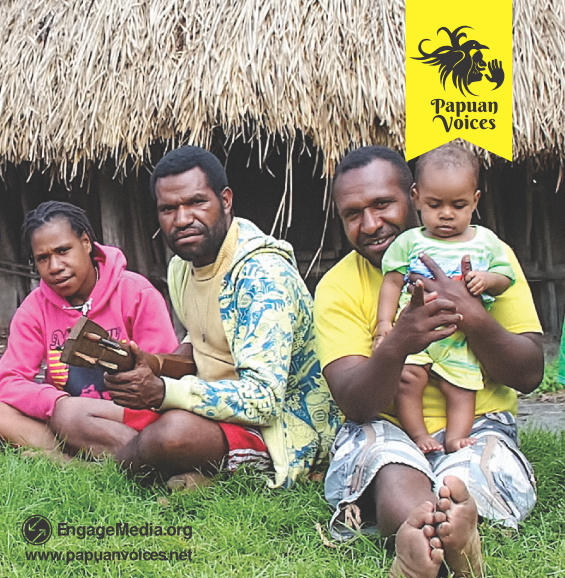
Engage Media, in association with Together with Belantara Papua and Yaysan
Teratai Hati Papua, has released a second volume of Papuan Voices documentaries,
These videos "tell the stories behind the conflict that are not often circulated:
the struggles for education, healthcare, equality and dignity." The videos
can be found at www.papuanvoices.net.
The site also includes additional resource materials, such as background
information, discussion and study guides, music, and more in in English
and Bahasa Indonesia.
This issue can be found at
http://etan.org/issues/wpapua/2015/1502.htm


|
|
||||

|
ETAN's other twitter accounts: |
||||
|
|
||||
|
|
||||
|
ETAN's Key Contact List |
Action alerts, media releases, key news and other resources on East Timor (Timor-Leste) and Indonesia selected by ETAN, focused on ETAN's program and priorities | ||||
|
|
Subscribe
to
ETAN's e-mail
Listservs on Timor, West Papua and Indonesia human rights |