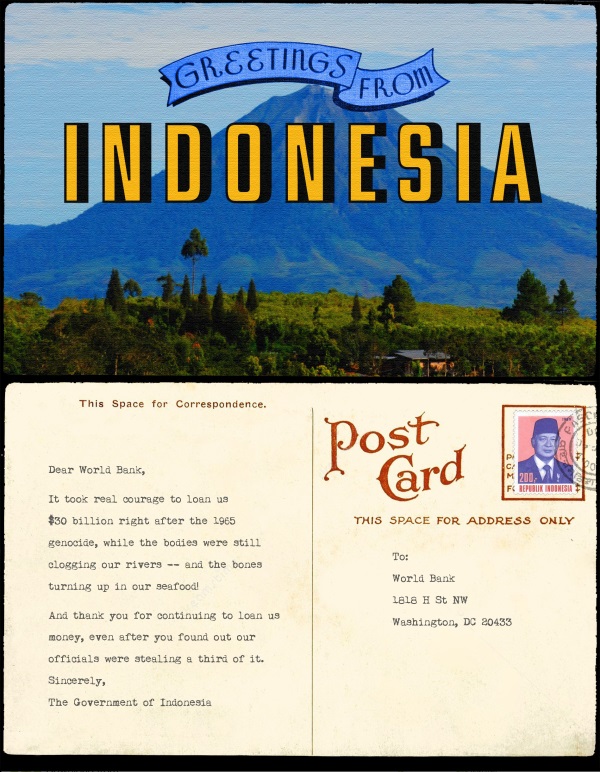
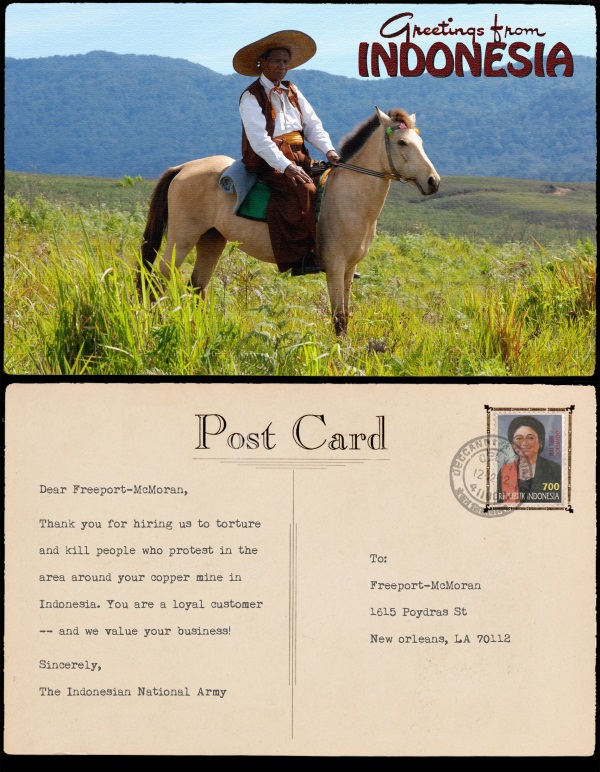
Found Buried
Deep in the Archives
ETAN's team of crack researchers found
this disturbing "thank you postcard" buried deep in
the archives in the back of a file
cabinet. The Indonesian military thanks TimeLife for its support.
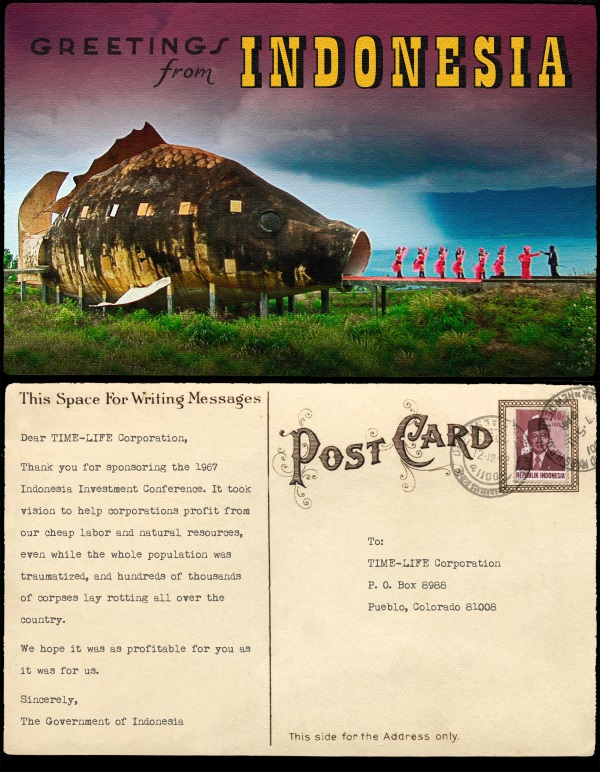
Graphic from Oscar-nominated documentary
THE ACT OF KILLING
From Chapter 2 of Power in Motion
by Jeffrey A. Winters
Among them
was James A. Linen, the President of
Time, Inc.
So taken
was Linen with the revolutionary changes
occurring around him that he offered to
sponsor a summit between the world's top
business executives--all of whom were
Linen's personal friends -- and key
members of Indonesia's Cabinet and
economic team. 26 In the words of
Indonesia's rapporteur, the
summit would allow "both sides, directly
and with open hearts, to discuss the
possibilities for foreign capital
investment in Indonesia." It was agreed
that an "Indonesian Investment
Conference" would be held in Geneva
early in November, 1967. Underscoring
the seriousness with which Suharto
viewed this first shot at an
international forum on investment, he
issued a Presidential Decree to give the
Indonesian delegation full authority to
represent the government. Its members
included the Economic and Foreign
Ministers, plus most of the top
government economists in charge of
investment, trade, and finance. In all,
twenty Indonesians went to Geneva, plus
two Ambassadors with staff in tow. 30 It
was a most impressive display.
While the Indonesian officials were
certain of their objectives, the means
to achieving them through the conference
had to be treated delicately. The
clearest and most forthright signals
possible had to be sent to these
business leaders. But at the same time,
these were some of the highest officials
of the Indonesian government, and they
had to maintain at least a public
display of dignity and pride. If they
appeared too eager or forthcoming, it
would provide ammunition to those back
in Jakarta who were disgusted at what
they saw as an obsequious posture of the
New Order toward creditors and
investors. A balance was struck by
making the summit a closed-door affair:
invited guests only, and no reporters.
In addition to private and official
views expressed to the press after the
conference, written summaries prepared
for selected audiences would be
circulated subsequently. [James A.
Linen, the President of Time, Inc.] and
Timor, In. would help reach out to the
broader business community through its
links to worldwide press channels. The
Indonesian embassies in the U.S. and
Europe, meanwhile, would distribute
nicely-crafted public relations
materials based on the summit.
The conference opened on 2 November with
a spirited address from Linen himself.
"We are trying to create a new climate,"
he said, "in which private enterprise
and developing countries work together
for their mutual interest and profit,
and to the even greater profit of the
free world." 32 Linen was personally
impressed with the signs of change in
the former Dutch colony. The Indonesian
guests had been brought to Geneva to
impress everyone else, or, as Time's
report of the proceedings put it, to
"make the case for Indonesia."
...
Press reports suggest that investors
were powerfully impressed with the
conference. "Sources said it largely
convinced many of the world's biggest
companies... that it was worth their
while to explore further the
possibilities of investment in
Indonesia."
....
Mohammad Sadli [the Chairman of the
Foreign Investment Team at the time of
the conference], who went on to hold
cabinet posts under Suharto, believes
that the impact of the investment
conference was substantial. Reflecting
on the proceedings--more than two
decades hence--he said,
The
conference in Geneva was very
important. It was a first in many
senses. [It] gave us our first
opening shot on drawing capital into
Indonesia. Immediately after that,
we got a big inrush of oil
investments. I don't know if there
was a direct link between the event
and the inrush, but there is no
doubt that the conference set the
tone for the years to follow. It
also gave us experience speaking on
behalf of Indonesia in front of the
world's top investors. It was very
successful. The Berkeley group knew
how to speak the language of these
business people.
He
maintains, also, that the early years of
the New Order were marked by an
extraordinary sense of urgency,
especially to get the country's
productive pumps primed. Still referring
to the conference, Sadli offered this
insight:
Overall, we were extremely
forthcoming in our presentation. We
were desperate to get new
investments and we were willing to
receive anything. With
Freeport,
which was the first generation of
new investments in Indonesia, I all
but said 'where is the dotted line
for me to sign on?'They were ready
to invest even before we had an
investment law under which to sign
the agreement. By the time of the
conference, however, we were more
ready.
Having
major players like Freeport blaze the
investment trail is extremely important
to others who want to invest but are
afraid they will lose everything. Ali
Budiardjo explains:
The
signing of the contract with
Freeport was highly publicized. For
the Indonesian government it meant
that a big company had confidence in
the government. This was important
so that others would follow. It did
happen, but only after a delay of
about a year. Other investors didn't
have the same courage as Freeport.
They were careful. Especially
politically, they wanted to be sure.
The big companies wanted to be sure
the PKI was destroyed. They also
wanted evidence that the government
knew what it was going to do. It was
important that Suharto surrounded
himself with economists.
From
January 1967 (when the Investment Law
was announced) to June 1968--a little
more than a half-year after the Geneva
conference--roughly 100 applications
worth almost half-a-billion dollars had
been received from prospective foreign
investors.
....
from fn. 28
Pan
American Airlines supplied a chartered
airplane for the Indonesian delegation,
while InterContinental Hotels
Corporation supplied accommodations. It
is not clear whether Linen paid for
these services, but it is certain that
the Indonesians did not. Mohammad Sadli
offers these recollections: "James Linen
was the kingpin of the whole conference.
I think he paid for it mostly by
himself. It must have been very
expensive.
From Pretext for Mass Murder by
John Roosa
(pp. 15-16)
While
preoccupied with Indochina in
1965,Washington was nothing short of
joyous as Suharto’s army defeated the
movement and rampaged against the
Communists. Sukarno’s neutrality in the
cold war and the PKI’s growing power
within the country were ended in one
fell swoop. Suharto’s army did what the
U.S. puppet state in South Vietnam could
not accomplish despite its millions of
aid dollars and thousands of U.S.
troops: it finished off its country’s
Communist movement. Within ten days of
the outbreak of the movement, the New
York Times reporter Max Frankel
already had noted that the mood in
Washington had brightened; his article
was headlined “U.S. Is Heartened by Red
Setback in Indonesia Coup.” He observed
that there was “hope where only two
weeks ago there was despair about the
fifth most populous nation on earth,
whose 103 million inhabitants on 4,000
islands possess vast but untapped
resources and occupy one of the most
strategic positions in Southeast Asia.”
As reports of the massacres arrived
during the months that followed, the
hope in Washington only grew. By June
1966 a leading editorial writer for the
New York Times, James Reston, had called
the “savage transformation” in Indonesia
“a gleam of light in Asia.” A Time
magazine cover story called Suharto’s
ascent “the West’s best news for years
in Asia.” Deputy Undersecretary of
State Alexis Johnson believed that the
“reversal of the Communist tide in the
great country of Indonesia” was “an
event that will probably rank along with
the Vietnamese war as perhaps the most
historic turning point of Asia in this
decade.”38 As Noam Chomsky and Edward
Herman have noted, the massacres in
Indonesia represented a “benign
bloodbath” and a “constructive terror”
because they served U.S. foreign policy
interests. While Washington adduced
every human rights violation in the
Soviet bloc as evidence of the iniquity
of the cold war enemy, it ignored,
justified, or even abetted atrocities
committed by governments allied with the
United States.
(pp. 27)
The joy at
his overthrow of Sukarno and destruction
of the PKI outweighed any humanitarian
considerations.
Such
priorities are apparent in Time
magazine’s cover story on Suharto in
July 1966. It correctly noted that the
“army was responsible for much of the
killing” and acknowledged that the
killing “took more lives
than the U.S. has lost in all wars in
this century.” Not shying away from gory
details, the article mentioned that some
suspected Communists were beheaded and
some corpses dumped in the rivers. But
then the article praised Suharto’s new
army-dominated regime for being
“strictly constitutional.” Suharto was
quoted as saying, “Indonesia is a state
based on law not on mere power.”72
Because the bloodbath was constructive
in terms of U.S. foreign policy
interests, Time could describe the
perpetrators in a wholly positive light,
even when this resulted in bizarre
juxtapositions of decapitated heads and
constitutional procedure.
From Time magazine:
Investment: Indonesia Waits, Friday,
Nov. 10, 1967
Last week in
Geneva, Indonesian Foreign Minister
Adam Malik and Economics Minister
Sultan Hamengku Buwono faced an
extraordinary audience of
businessmen.* In a three-day meeting
sponsored by Time Inc., top
executives of European, Japanese,
Australian, Canadian and U.S.
companies gathered to hear just how
vital foreign investments can be to
the future of Indonesia. ...
* A sampling:
Gianni Agnelli, chairman, Fiat;
George W. Ball, chairman, Lehman
Bros. International; Eugene Black,
director, Chase Manhattan Bank;
Norton Clapp, chairman, Weyerhaeuser
Co.; Howard L. Clark, president,
American Express; Russell R. De
Young, chairman, Goodyear Tire &
Rubber Co.; Floyd D. Hall,
president, Eastern Airlines; Robert
V. Hansberger, president, Boise
Cascade; John D. Harper, president,
Aluminum Co. of America; Earl B.
Hathaway, president, Firestone Tire
& Rubber Co.; H. J. Heinz II,
chairman, H. J. Heinz Co.; Robert C.
Hills, president, Freeport Sulphur
Co.; Edward B. Hinman, president,
International Paper Co.; Dr. Koji
Kobayashi, president, Nippon
Electric Co.; Rudolph A. Peterson,
president, Bank of America; Frederik
Jacques Philips, president, N. V.
Philips' Gloeilampenfabrieken; David
Rockefeller, president, Chase
Manhattan Bank; Dr. Samuel Schewizer,
chairman, Swiss Bank Corp.; Dr. Gerd
Tacke, director, Siemens A.G.;
Abderrahman Tazi, executive
director, International Bank for
Reconstruction and Development
From
Globalisation in Indonesia: Spoils of a
Massacre, report by John
Pilger, Guardian Weekend 14 July
2001
In
November 1967, following the capture
of the "greatest prize", the booty
was handed out. The Time-Life
Corporation sponsored an
extraordinary conference in Geneva
which, in the course of a week,
designed the corporate takeover of
Indonesia.
It was attended by the most
important businessmen in the world,
the likes of David Rockefeller, and
all the giants of western capitalism
were represented. They included the
major oil companies and banks,
General Motors, Imperial Chemical
Industries, British Leyland,
British-American Tobacco, American
Express, Siemens, Goodyear, the
International Paper Corporation, US
Steel.
Across the table were Suharto's men,
whom Rockefeller called "Indonesia's
top economic team". Several were
economists trained at the University
of California in Berkeley. All sang
for their supper, offering the
principal selling points of their
country and their people: "Abundance
of cheap labour . . . a treasure
house of resources . . . a captive
market." Recently, I asked one of
them, Dr Emile Salim, if anyone at
the conference had even mentioned
that a million people had died in
bringing this new business-friendly
government to power. "No, that was
not on the agenda," he replied. "I
didn't know about it till later.
Remember, we didn't have television
and the telephones were not working
well."
The Indonesian economy was carved
up, sector by sector, at the
conference. In one room, forests in
another, minerals. The Freeport
Company got a mountain of copper in
West Papua (Henry Kissinger is
currently on the board). A
US/European consortium got West
Papua's nickel. The giant Alcoa
company got the biggest slice of
Indonesia's bauxite. A group of US,
Japanese and French got thetropical
forests of Sumatra, West Papua and
Kalimantan.
A Foreign Investment Law, hurried on
to the statutes by Suharto, made
this plunder tax-free for at least
five years. Real, and secret,
control of the Indonesian economy
passed to the IMF and the World Bank
through the Inter-Governmental Group
on Indonesia (IGGI), whose principal
members were the US, Canada, Europe
and Australia. Under Sukarno,
Indonesia had few debts. Now the
really big loans rolled in, often
straight into pockets, as the
treasurehouse of resources rolled
out. Shortly before the Asian
financial crash in 1997, the IGGI
godfathers congratulated their
favourite mass murderer for having
"created a miracle economy.
About East Timor and Indonesian
Action Network
The East Timor and
Indonesia Action Network (ETAN)
advocates for democracy, justice and
human rights for Timor-Leste, West Papua
and Indonesia. In 2012, the government
of the Democratic Republic Timor-Leste
awarded ETAN the Order of Timor (Ordem
Timor) for its role in the liberation of
the country. More information about ETAN
can be found at:
http://www.etan.org