“Yet the silence in the title also
refers to our silence. Because the
Indonesian genocide is not just
Indonesian history, but American
history. The U.S. provided weapons,
money, and training to the death squads,
and lists of thousands of names of
public figures whom United States wanted
killed. We in the us must do the same
work as Indonesians. We must declassify
the documents that reveal our role in
these crimes, and take responsibility” -
Joshua Oppenheimer at Independent Spirit
Awards
Take
Action on U.S. Support for Mass Violence
and Genocide
in Indonesia
THE
MASSACRE of up to 1,000,000 communists,
leftists, ethnic Chinese, and others in
Indonesia in 1965-1967 is a key event in
modern Indonesian political history, but
it remains mostly a footnote for most in
the United States and elsewhere.
The documentary THE ACT OF KILLING
shocked audiences as perpetrators of the
mass murder reenacted their violence.
The film has fueled a debate within
Indonesia and drawn attention
internationally to events unknown to
many. Events that the U.S. facilitated
and cheered at the time.
THE
LOOK OF SILENCE flips the story by
following Adi Rukun's investigation into
the death of his older brother who was
murdered during the violence. Like its
Oscar-nominated predecessor, THE LOOK OF
SILENCE was recently nominated for an
Academy Award for best documentary.
These powerful
films tell us as much about Indonesia today
as they do about the past. However, any
evaluation of the events of 1965-1967
must include a discussion of the role of
Western powers in the violence,
especially the United States. The
East Timor
and Indonesia Action Network
(ETAN) continues to call for
accountability for those in the West who
encouraged and assisted in the mass
violence in Indonesia from 1965 on. The
full truth must come out; the U.S.
should declassify all files related to
Suharto's U.S.-backed seizure of power
and the murderous events which followed.
ETAN urges you to see films and take action on
U.S. accountability for its role in the
massacres that followed Suharto's brutal
seizure of power.
1) Support
S.Res. 273. Call your Senators and urge them to
cosponsor Senator Tom Udall's (D-NM)
resolution condemning the 1965-1966 mass
murder in Indonesia and expressing
concern about the lack of accountability
for these crimes.
Call the Capitol Switchboard
- (202) 224-3121 - and ask for your
Senators' offices. Once connected ask
for the Senator or a foreign policy aide. Urge the
Senator to co-sponsor Senate Resolution
273 on Indonesia, summarize the
resolution, and a give your reasons why
you believe it is important. Stress
the need for both the U.S. and Indonesia
to acknowledge the past by releasing all
its documents from 1965/66. By taking
responsibility for its role in these
crimes, the U.S. will be supporting
justice, reconciliation and assist
efforts in Indonesia to hold its
security forces accountable and to lift
ongoing restrictions on freedom of
expression.
Please encourage others
to call. Be sure to follow-up with an
email or another call.
Let us know the results of your
calls.
S.Res. 273 urges Indonesia to consider a truth, justice,
and reconciliation commission to address
crimes against humanity and other human
rights violations and calls on the U.S.
government departments and agencies
involved in developing and implementing
policy towards Indonesia at the time to
locate, recommend for declassification,
and make available to the public all
records from that time. Read more about
the S.Res. 273 here:
http://etan.org/news/2015/10senate.htm.
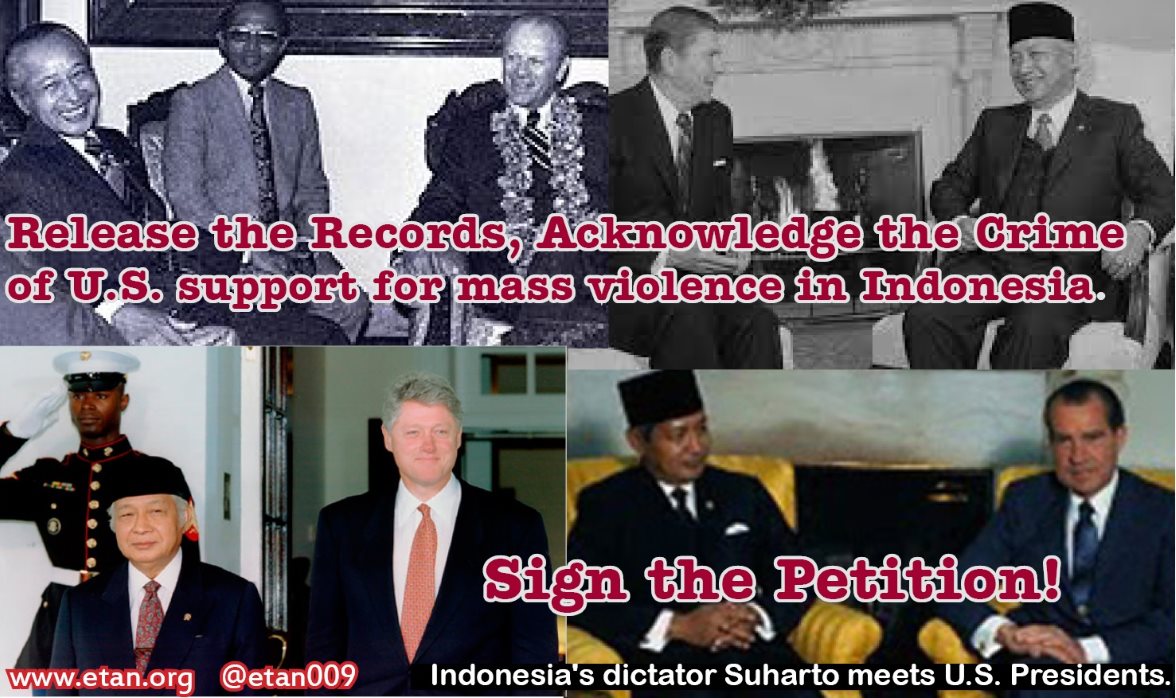
2) Sign
our petition urging the
U.S. government to take two immediate
steps:
a) declassify and release all
documents related to the U.S. role
in the 1965/66 mass violence, and b)
formally acknowledge the U.S. role
in facilitating the 1965-66 violence
and its subsequent support for the
brutalities of the Suharto regime.
3)
Watch the THE LOOK OF SILENCE and
THE ACT OF KILLING. Both films are
available on DVD and Blu-Ray or for
streaming on Amazon and elsewhere.
(Support ETAN by watching or ordering
the films on Amazon.) Order
discs or watch The Look of Silence from
here:
http://amzn.to/1T7VECP or The Act of
Killing here:
http://amzn.to/1O39rEc.
4)
Organize a discussion of the films.
Use our
brief discussion guide, and
let us know
if you organize a showing or discussion or
have any suggestions or comments. If you are
high school teacher or college professor
teaching an appropriate subject,
consider assigning THE ACT OF KILLING
or THE LOOK OF SILENCE to your students.
Use it as a springboard for discussions
on the impact of U.S. foreign policy,
the need to address human rights
violations, and how the past affects the
present. (Contact:
Chris Lundry.)
5)
Spread the word about the petition and
the film. Write a letter to the editor
and post to facebook or other social
media calling for the U.S. to take
responsibility for its role in the mass
killings in Indonesia.
Go here for sample letters, tweets
and facebook posts. It is best to use
your own words. (Also use ETAN's
Backgrounder:
Breaking the Silence: The U.S. and
Indonesia's Mass Violence for
additional information.)
Any
time is a good time to spread the word;
an especially effective time is in
response to Oscar nomination of THE LOOK
OF SILENCE and if it should win.
5)Support ETAN. We need your
support to continue our work for justice
and accountability.
Please
donate today.
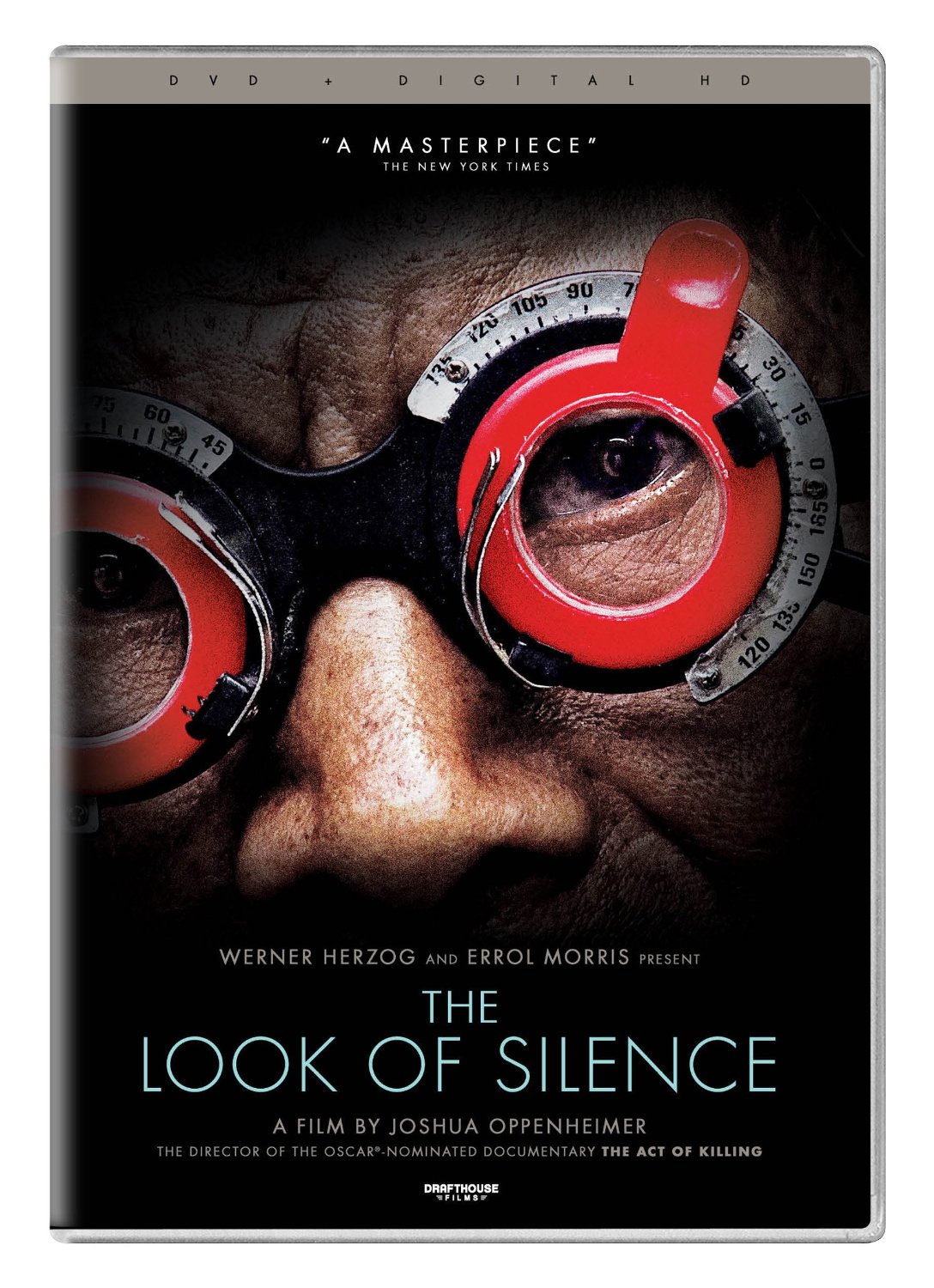
THE
LOOK OF SILENCE is Joshua
Oppenheimer's powerful companion piece
to the Oscar-nominated The Act of
Killing. The Look of Silence is in
contention for Best Documentary at this
year's Academy Awards. The film
explores one of the 20th century's
deadliest atrocities through a family
that lost their eldest son. These
massacres remain largely hidden after 50
years. Indonesia's 1965 army-led purge
and killing of as many as one million
people. The family discovers years later
who killed their son and how, and they
must confront how privileged, dangerous,
and close at hand the killers remain.
The younger son, an optometrist named
Adi, breaks the half-century of fearful
silence with an act the film calls
"unimaginable in a society where the
murderers remain in power." While
testing the eyesight of the men who
killed his brother, Adi confronts them.
He challenges them to accept
responsibility for their violence.
Oppenheimer writes that the film depicts
"a silence born of terror," and "the
necessity of breaking that silence, but
also ... the trauma that comes when that
silence is broken." More information
about the film can be found here:
http://thelookofsilence.com/
About THE ACT OF KILLING
In The Act of Killing,
directed by Joshua Oppenheimer and
executive produced by Errol Morris and
Werner Herzog, the filmmakers expose a
corrupt regime that celebrates death
squad leaders as heroes. When the
Indonesian government was overthrown in
1965, small-time gangster Anwar Congo
and his friends went from selling movie
tickets on the black market to leading
death squads in support of the military
dictatorship. Anwar boasts of killing
hundreds with his own hands, but he's
enjoyed impunity ever since, and he has
been celebrated by the Indonesian
government as a national hero. When
approached to make a film about their
role in the genocide, Anwar and his
friends eagerly comply -- but their idea
of being in a movie is not to provide
reflective testimony. Instead, they
re-create their real-life killings as
they dance their way through musical
sequences, twist arms in film noir
gangster scenes, and gallop across
prairies as Western cowboys. Through
this filmmaking process, the moral
reality of the act of killing begins to
haunt Anwar and his friends with varying
degrees of acknowledgment, justification
and denial. More information about the
film can be found here:
http://actofkilling.com/.
Order the film here: http://amzn.to/1O39sYL.

 THE
MASSACRE of up to 1,000,000 communists,
leftists, ethnic Chinese, and others in
Indonesia in 1965-1967 is a key event in
modern Indonesian political history, but
it remains mostly a footnote for most in
the United States and elsewhere.
THE
MASSACRE of up to 1,000,000 communists,
leftists, ethnic Chinese, and others in
Indonesia in 1965-1967 is a key event in
modern Indonesian political history, but
it remains mostly a footnote for most in
the United States and elsewhere.